
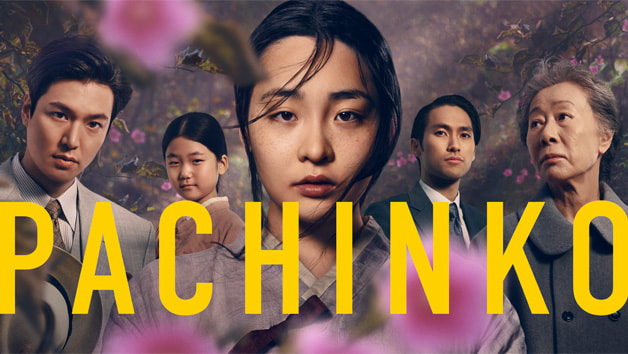
Pachinko, the book and the TV show, is a multi-generational saga of a Korean immigrant family’s life from the early 20th century to the post World War II era and into the 80s. It all started in the world of Sunja and the consequences of her decisions on her life and the people around her. With its clever non-linear storytelling and vibrant characters, it explores themes of identity, family, betrayal, discrimination, love, hope and pursuit of dreams against the backdrop of historical, cultural, national and global changes.
- 2022
- Genre: Drama, Historical, Family Saga
- Created by: Soo Hugh
- Starring: Youn Yuh-jung (Older Sunja), Kim Min-ha (Teen/Adult Sunja), Yuna (Young Sunja), Lee Min-ho(Koh Hansu), Soji Arai (Baek Musazu), Jin Ha (Solomon Baek), Anna Sawai(Naomi)
Disney has a definite winner in Pachinko TV Show. I am so excited to experience a live action of one of the most interesting books I’ve read that involves Korean and Japanese history, with a splash of romance and family saga.
The story begins when Sunja meets the dashing and ambitious Hansu, played by Lee Min-ho, at the fishmarket she often visits to buy supplies for their boardinghouse.
Hansu is a Zainichi Korean, a Korean who lived in Japan before 1945. Hansu grew up poor but had the chance to get out of Korea and experience the world. He is aloof and has a cold exterior because of all the challenges and tragedy he went through. But a respected broker who often comes to Korea to make deals in the fish market.
 Image Source (Apple TV)
Hansu is captivated with Sunja’s innocence, while Sunja is drawn to his attentiveness, confidence and stories of the world that are out of her grasp. They meet in secret everytime Hansu is in town.
This forbidden love sets the stage for the captivating and whirlwind life that Sunja leads.
 Image Source (Apple TV)
She was promised the world by Hansu, to give her the life she couldn’t imagine and live without worrying about money. But when the news of her pregnancy revealed the truth about Hansu’s wife in Japan, Sunja couldn’t accept that she will be a mistress. She is heartbroken and was forced to deal with the pregnancy alone. While Hansu went back to Japan.
Pregnancy out of wedlock during that time was a taboo. But as luck would have it, a sickly Protestant minister who came to Korea to preach, Baek Isak, played by Noh Sang-hyun, arrived very ill and was taken in by Sunja’s mother despite the risk of being imprisoned for welcoming a preacher of a different religion other than Buddhism. Learning about Sunja’s predicament, he offered to marry Sunja to save her honor in return for her mom’s kindness to him.
This marriage sets Sunja to sail to 1920’s Osaka, Japan with Baek Isak. They lived with Baek Isak’s brother, Baek Yoseb and his wife, Kyunghee. Although she refused to marry the minister at first because she didn’t want to burden him and wasn’t in love in the beginning, she was able to accept him and give him the respect and eventually the deep love that he deserved.
Sunja soon realized that the living conditions in Japan are not what it was advertised to be, it is definitely not greener pastures. She decided to be useful and started working despite everyone’s objection due to her pregnancy.
This is when we learn of Sunja’s and the entire family’s resilience and pragmatic look at life. On how they dealt with hardship, triumphs, losses and jaw dropping moments. On how they built their family despite all the roadblocks that hindered their freedom and success during that 1920’s era and in 1980’s Japan.
 Image Source (Apple TV)
OUR TAKE ON PACHINKO!
I have read the book in two sittings – it has many pages 🙂 So I was very interested and curious on how they will execute the story in the show.
Boy oh boy, I was bewildered by how wonderful it is.
Story and storytelling
It is a show about the story of how an immigrant tries to assimilate and be accepted in a country that is very much seen as a bully to outsiders at that time, especially to Koreans.
The show follows a non-linear storytelling approach, jumping between time periods and characters. It moves freely from different eras in Sunja’s life, mainly from her young adulthood in the 1920’s and her grandson’s early adulthood in the 1980’s. I loved how this was done because it is not through flashbacks, but through magical storytelling that added depth and layers of complexity to the narrative. It might be confusing for some viewers because it definitely requires keen attention to detail to fully grasp the interconnected timelines. However, I feel that it made the show more interesting and engaging, making me invested in the fates of the character. It makes you want to know the answer to some events that arose elsewhere in her lifetime. And makes you curious of what’s going to happen next because of younger Sunja’s decisions and actions.
I am not well informed with the history of Japan and Korea at that time. But based on the little research and reading I did, I think the show offered an objective perspective on the challenges faced by Koreans living in Japan during that tumultuous period.
Cinematography and Production Design
The lush scenes and meticulous production design were astounding. It is visually stunning and a feast for the eyes. The detailed costumes, evocative set pieces, the vibrant color palette, created a backdrop that enhances the storytelling. It makes you understand and feel what it was like to live during the different eras. It is truly a cinematic treat.
Episode 7, for instance, which depicted the great Kanto earthquake and massacre, is one of the episodes that dove into what epic means when it comes to designing and lighting the sets. You can feel how horrible it is to breathe the air after the earthquake, the horror, the fear, the panic and the hardships the people did back then to survive.
 Image Source (Apple TV)
Actors
And of course, the actors – I am in awe of the ensemble cast. They all delivered powerful performances breathing life into characters that span multiple generations.
Sunja’s dad is one of the characters that breaks my heart the most. He is an outcast due to his deformities but that didn’t limit him to be kind to others and give everything he has for Sunja. His performance of how a dad should be despite all the hardships made his death so heartbreaking to watch.
Lee Min-ho, as Koh Hansu, a character that serves as an alternate life for Sunja, is fantastic. He has that ability to exude confidence on screen while also showing vulnerability.
Sunja’s mom was amazing. Although strict with Sunja most of the time, she agreed to have her wed and leave the nest. And she went to great lengths to prepare a wedding feast for the newlyweds with rice – yes rice. Only the privileged and the rich are allowed to buy rice and can buy rice. But she made her way to the market and bargained hard and risked it all just so she could give her only daughter a wedding feast.
There are so many more fantastic performance. But of course, the performances of each Sunja is what transforms the series throughout.
Child Sunja, played by Yuna, is amazing. You wonder where she got that emotional depth at such an early age.
Teen/Adult Sunja, played by Kim Minha, is astounding,It was utterly poignant when adult Sunja was eating the rice. Kim Min-ah was brilliant, you can feel her emotions come through the screen when she was so teary eyed to see the rice her mom prepared. She knew the significance and the sacrifice – monetary and safety wise – that her mom went through just to have the spread prepared. And you felt that though there were no words spoken, just Kim Min-ah’s acting, her face was happy and sad at the same time. It’s so vivid, you can utterly feel it.
I also can’t forget adult Sunja’s deep sorrow of leaving her mother and South Korea to be with her husband. That scene took my breath away.
Youn Yuh-jung as the older Sunja is excellent. The way she portrays the wisdom of a woman who has gone through deep sorrow and hardships in life, is amazing.
In every scene, in every period, Sunja just delivers. Both teen and older Sunja’s emotional reaction flashes across their faces which provide a key to their family saga. Everytime they are on screen, you see how they ground the family through overwhelming events. She portrayed the resilience and strength of a woman that holds a family together, her emotions showing even without dialogue, but you can feel it through the screen. Sunja is both remarkable and ordinary.
Let’s just say that I went through lots of tissues to get through these scenes.
 Image Source (Apple TV)
So what say I?
This show is certainly one of the best that 2022 had to offer. It truly delivers the metaphor that life is like a Pachinko – a game of chance. It’s unpredictable, sometimes you win, sometimes you lose. Other times you are heartbroken, the next you are full of hope.
I am in awe of how this TV show has created an epic family drama that is intimate but also vast at the same time. The brilliant storytelling is thought provoking, visually stunning and emotionally resonant.
I am actually dumbfounded to learn that this was not nominated for any awards in 2022 or 2023. What the what?!? is all I can say…
If you are a fan of historical dramas or family sagas, this one will be for you. The show is a delightful journey through the decades with its masterful storytelling with a blend of drama and culture.It is really worth the binge.
If you still have not watched it, why not? Why? Go for it. It is certainly worth your time and emotions.